|
|
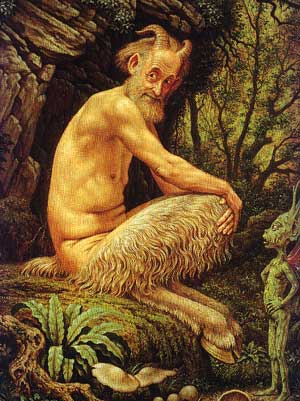
SELF-PORTRAIT AS FAUN (1985)
(Zelfportret als faun)
|
The first important work to emerge in this period is Johfra’s last self portrait. In Self Portrait as a Faun (1985), he appears entirely at home in nature and, indeed, recognizes himself as part beast. Now Pan’s horns and cloven hooves have taken over the artist himself. Not as a great pagan god, but a more lowly satyr with a smile and side glance that betoken much humour and wisdom. He is the wise old man of the forest, mischievous, lusty and playful - a trickster.
|
|
|
|
|
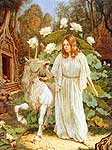
LA DAME A
LA LICORNE
1984
(Click on any
image to
enlarge)
|
Parallel with the self portrait are a fourfold series of Ellen portraits called Morning, Noon, Evening, and Night and a ninefold series of landscapes called Ellen in Wonderland. In 1984 he painted the large La dame a la Licorne, which portrays Ellen as the lady who has tamed the unicorn. Much of the imagery and even the style of painting in this picture are taken from Ellen’s own works, as if Johfra wanted to render hommage to her not only as wife but as artist in her own right.
|
(For more on Ellen Lórien and her painting, see the Gallery and article on Ellen Lórien)
Viewing these works in the greater context of Johfra’s evolution as an artist, we see that his perception of himself and his wife has become fixed as distinctive personalities at home in Nature - Nature that is not only rich in detail (the Pantheist view), but also has profound symbolic qualities (himself as a satyr and Ellen as encircled by lotus flowers and waterlilies). The two types of flower in this painting - the lotuses behind her and the waterlilies in the pond below - are rich in their associated symbolism of Buddhist wisdom and awakening. The unicorn, we may surmise, is Johfra himself, making this a kind of wedding portrait. According to legend, the unicorn is a wild and untamed beast which nevertheless may be captured and tamed by a virgin.
|
|
|
|