|
|
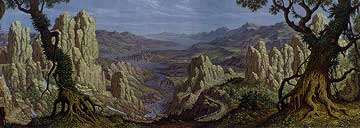
VALLEY WITH THREE TREES
1991
|
The last decade of his life also bears witness to the birth of a whole series of broad landscape paintings (several of which were left at the grey underpainting stage when he died). Three times wider than they are high, the concern here is to represent nature as a panoramic vista. Mountains, seas, cliffs and ruins - these are all present. But the prinicple preoccupation is to render atmospheric light, and the numerous shades of grey and blue which intercede between horizon and foreground.
A page from the notebooks reveal how Johfra has indeed worked out the twenty possible contrasts of light and dark which create atmosphere. In the panoramic landscapes, he applies these variations one after another. Having mastered the rendering of water, fire, and earth in earlier canvases, he has now turned to the most ethereal and invisible of elements - air. Despite the obvious, these paintings do not depict
|
|
|
|
|
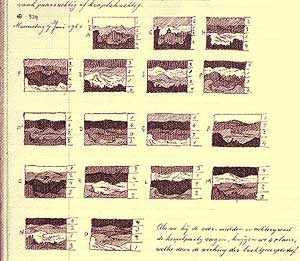
COMPOSITIONAL POSSIBILITIES
OF LANDSCAPES IN FOUR PLANES
(Composotie-mogelijkheden
van landschappen in vier plans)
|
mountains, seas, cliffs, and ruins. They are studies of the air which interposes itself between the viewer and these objects as atmosphere and light.
Thus the four elements which swirled around Pan in the great triptych have become, each in their own way, a gripping obsession for the artist. His last years are spent, like the Magician of the Tarot Arcana, trying to master earth, air, fire, and water through their representation in art.
|
|
|
|